

Direct mail costs roughly $0.50 to $1.40 per piece all in for common formats in 2026, according to published industry ranges. Postage is the part you can look up: bulk USPS Marketing Mail letters run $0.255 to $0.467 each, Every Door Direct Mail Retail is $0.260, and a First-Class stamp is $0.82, per USPS Notice 123. Printing is the part that moves with format, paper, quantity, and finishing. This guide breaks both apart so you can size a campaign before you ever ask for a quote.
Key Takeaways
- Direct mail cost has two parts: producing the piece (printing) and postage. They are quoted separately because different choices move each one.
- All-in per-piece pricing for common formats runs roughly $0.50 to $1.40, depending on size, stock, and quantity, according to published 2026 industry ranges.
- Postage is set by the USPS. A First-Class postcard is $0.65 and a Forever letter stamp is $0.82 as of July 12, 2026, while Every Door Direct Mail costs $0.26 per piece.
- Bulk mail postage runs $0.255 to $0.467 per letter on USPS Marketing Mail, depending on how finely the mailing is sorted, per USPS Notice 123.
- Bigger runs and deeper presort lower your cost per piece. Savings of 15 to 25 percent are common once a mailing is optimized for postage.
- The spend tends to pay back: direct mail to a house list posts a 5 to 9 percent response rate and a median return on investment above paid search and display, per the ANA Response Rate Report.
How much does direct mail cost?
There is no single number, because a mailing is really two costs stacked together. Postage is published and verifiable: a First-Class Mail stamp sits at $0.82 as of July 12, 2026, and EDDM Retail is a flat $0.26 per piece. Printing is the half that moves, and it depends on format, paper, quantity and finishing.
That is why a 4 by 6 postcard and a 6 by 9 envelope with a brochure inside are not remotely the same job. Rather than quote you a market average that may not describe your piece, send us the format, the quantity and the deadline and we will price the print and the postage separately so you can see which half is driving the number.
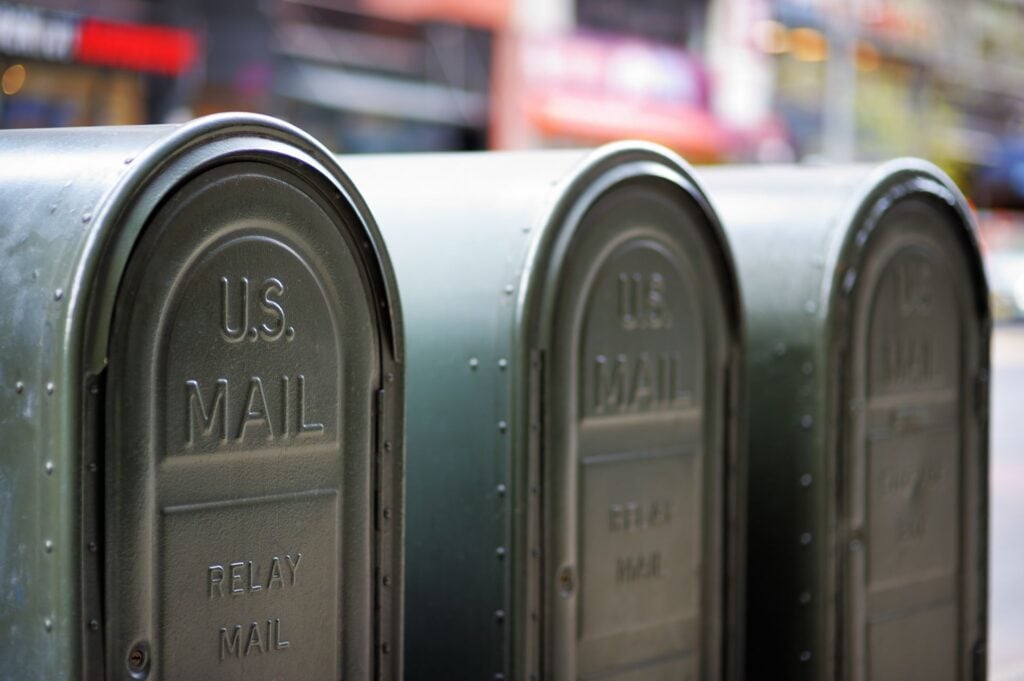
That spread exists because direct mail is not one product. It is a postcard, a folded self-mailer, or a full envelope package, each printed and mailed differently. The honest answer to “how much does it cost” is always “it depends on the piece,” which is exactly why reputable printers quote the print and the postage as two separate lines. MPress does this on every job that runs through our direct mail printing and mailing service, so you can see the trade-off instead of a single blended figure.
The two costs inside every mailing
Direct mail pricing is printing plus postage, and the two rarely move in the same direction. A heavier, glossier postcard costs more to print but may still mail at the same postage rate as a plain one. A larger piece can cross a size threshold that changes its postal class and its per-piece postage entirely. That is the core reason a good quote splits the two.
Printing covers prepress, paper stock, ink coverage, cutting, folding, and any personalization. Postage covers the class of mail, the weight, and the presort level you qualify for. Because those levers are independent, the smart move is to design the piece and choose the mail class together, not one after the other. Get that pairing right and you can hold quality while trimming the postage line.
What postage actually costs in 2026
Postage is a published USPS rate, not something a printer sets, so it is the one part of your cost you can look up. As of July 12, 2026, a First-Class Mail Forever stamp is $0.82, a domestic postcard is $0.65, and a metered one-ounce letter is $0.78, according to the U.S. Postal Service. Those are the rates for small, unsorted, first-class mailings.
Most businesses mailing at volume do not use First-Class, though. They use USPS Marketing Mail, the discounted bulk class that requires a minimum of about 200 pieces and rewards you with lower per-piece postage in exchange for presorting and paperwork. The deeper you sort by ZIP Code and carrier route, the less each piece costs. Marketing Mail is where most addressed campaigns live, and the exact rate depends on how far you sort, which is why volume changes the math.
The two halves of the price
Postage is published, printing is quoted
Postage you can look up. Print depends on format, paper, quantity and finishing.
Postage: USPS Notice 123 price list, effective July 12, 2026, checked September 22, 2026. Response rates: PIworld reporting ANA figures.
Pricing a real mailing? Send your quantity, piece size and target area through the quote form and we will break out print and postage separately, so you can see which half of the budget your choices are actually moving.
How much does bulk mail cost?
Bulk mail postage costs $0.255 to $0.467 per letter in 2026 with USPS Marketing Mail, the class most bulk mail uses. Where you land depends on how finely the mail is sorted: $0.395 for automation letters sorted to 5-digit ZIP Codes, $0.467 for mixed automation, and $0.255 for a saturation mailing to every address on a carrier route. These are USPS prices effective July 12, 2026, under USPS Notice 123.
Nonprofits with USPS authorization pay less: $0.185 per 5-digit automation letter, and $0.160 at carrier route saturation. Presorted First-Class Mail costs more, $0.621 to $0.707 per letter. Every Door Direct Mail Retail is $0.260 per piece with no mailing list and no permit.
Bulk rates are not a counter discount. A Marketing Mail mailing needs at least 200 pieces or 50 pounds, and presorted First-Class needs at least 500. USPS charges a $390 annual mailing fee for each class. MPress presorts the mailing, completes the postal documentation, and drops it with USPS, which is part of what qualifies it for these rates.
| Mail class and sort level | Postage per piece | Minimum per mailing |
|---|---|---|
| Marketing Mail letter, carrier route saturation | $0.255 | 200 pieces or 50 lb |
| Marketing Mail letter, 5-digit automation | $0.395 | 200 pieces or 50 lb |
| Marketing Mail letter, 3-digit/SCF automation | $0.435 | 200 pieces or 50 lb |
| Marketing Mail letter, mixed automation | $0.467 | 200 pieces or 50 lb |
| Nonprofit Marketing Mail letter, 5-digit automation | $0.185 | 200 pieces or 50 lb, with USPS nonprofit authorization |
| First-Class presort letter, 5-digit to mixed | $0.621 to $0.707 | 500 pieces |
| First-Class presort postcard, 5-digit to mixed | $0.453 to $0.495 | 500 pieces |
| Every Door Direct Mail Retail, flats up to 3.3 oz | $0.260 | 200 per mailing, up to 5,000 a day per ZIP Code, no permit |
| Single-piece stamp, letter or postcard, for comparison | $0.82 / $0.65 | None |
Letter prices are for pieces weighing 3.5 ounces or less, at no destination-entry discount. Source: USPS Notice 123, effective July 12, 2026. Minimum volumes: USPS Domestic Mail Manual 243 and 233.
What postage costs on 1,000 and 5,000 pieces
Postage only, at USPS Notice 123 prices. Printing and mail preparation are quoted separately.
| Option | 1,000 pieces | 5,000 pieces |
|---|---|---|
| First-Class stamps, $0.82 | $820 | $4,100 |
| First-Class presort, mixed automation, $0.707 | $707 | $3,535 |
| Marketing Mail, mixed automation, $0.467 | $467 | $2,335 |
| Marketing Mail, 5-digit automation, $0.395 | $395 | $1,975 |
| Every Door Direct Mail Retail, $0.260 | $260 | $1,300 |
Arithmetic on the per-piece prices in USPS Notice 123. Letter prices apply to pieces up to 3.5 ounces; EDDM Retail applies to flats up to 3.3 ounces. Print, list, and mail preparation are not included.
What printing adds to the price
Printing is the half of the bill you control most directly, and four choices drive it: size, stock, color, and quantity. A postcard on standard card stock is the cheapest thing to produce. Add heavier paper, a soft-touch coating, a fold, or an inserted brochure, and each step raises the per-piece print cost. Published 2026 ranges put a 6-panel folded self-mailer at $0.75 to $1.10 and a two-page letter with an insert at $0.70 to $1.05, printing and postage combined.
Quantity is the biggest lever. Per-piece printing drops sharply as the run grows, because setup costs spread across more pieces. Personalization is the other variable. Variable data printing changes the name, offer, or code on every piece in a single pass, which lets you run donor, admissions, and loyalty versions without stopping the press. Whether you print those pieces on a digital press or offset depends on quantity, and that choice shows up in the quote too.
EDDM versus addressed mail: which is cheaper?
Every Door Direct Mail is usually the cheaper way to blanket an area, because you skip the mailing list and mail to every address on a postal route. EDDM Retail postage is a flat $0.26 per piece, and you can send at least 200 and up to 5,000 pieces per day per ZIP Code with no mailing permit, per the U.S. Postal Service. No list to buy, no permit to hold, lower postage per piece.
Addressed direct mail costs more per contact but hits harder where precision matters. It targets named recipients, so it needs a list, and it allows the personalization that pushes response. The rule of thumb: use EDDM when you want saturation of a neighborhood on a budget, and use addressed mail when you want to reach specific people with a tailored offer. Many campaigns use both, saturating with EDDM and following up named prospects with a personalized letter.
Is direct mail worth the cost?
For most offers, yes, and the response data is the reason. Direct mail sent to a house list of existing customers averages a 5 to 9 percent response rate, while prospect lists average 4 to 5 percent, according to figures from the ANA Response Rate Report reported by Printing Impressions. The same reporting puts direct mail’s median return on investment at 112 percent, ahead of paid search at 93 percent and online display at 89 percent.
Physical mail also gets acted on. A recent industry survey found that 62 percent of consumers said direct mail inspired them to take action, and pairing mail with email pushed combined response toward 27 percent, per Lob. None of that makes a bad offer work, but it does explain why a postcard can out-earn a much cheaper email when the list and the message are right.
How to lower your direct mail cost per piece
The fastest way to cut cost per piece is to mail more pieces and sort them deeper. Per-piece costs fall materially at higher volumes, and presorting or co-mingling qualifies a mailing for lower USPS rates rather than paying full retail postage on every piece. Those are savings you keep on every drop, and we handle the presort and the paperwork as part of our direct mail service.
A few more levers stack on top:
- Right-size the piece. Staying inside a postal size and weight band keeps you in the cheaper class. A piece that creeps over a threshold can jump a full rate tier.
- Batch your drops. Larger, sorted mailings qualify for deeper discounts than frequent small ones.
- Let the printer handle the postal work. MPress presorts, completes the documentation, and drops the mailing with USPS after you approve a proof, which protects your rate and avoids rejections at the counter.
Ready to price a real job? Request a quote, upload your file, or call (504) 524-8248 and we will break out the print and the postage so you know exactly what you are paying for.
Frequently Asked Questions
How much do mailers cost?
A mailer carries two costs stacked together, the print and the postage, so common formats land at roughly $0.50 to $1.40 per piece all in, according to published 2026 ranges. A 4 by 6 postcard is the cheapest to produce, while a folded self-mailer runs about $0.75 to $1.10 and a letter with an insert about $0.70 to $1.05. Postage is a published USPS rate you can look up, from $0.26 per piece for Every Door Direct Mail to $0.65 for a First-Class postcard, so send us the size and quantity and we will price the print and the postage separately.
What is the cost of bulk mail?
Bulk mail postage is $0.255 to $0.467 per letter with USPS Marketing Mail in 2026, depending on how finely the mailing is sorted, per USPS Notice 123. Automation letters sorted to 5-digit ZIP Codes pay $0.395. You need at least 200 pieces or 50 pounds, and USPS charges a $390 annual mailing fee. Every Door Direct Mail Retail is $0.260 per piece for 200 to 5,000 pieces a day per ZIP Code, with no permit. MPress presorts and completes the paperwork so your mailing qualifies for the discounted rate.
Do I need a permit to send bulk mail?
For Marketing Mail and presorted First-Class Mail, yes. USPS charges a $390 annual mailing fee for each class, per 12-month period, at the post office where the mail is entered. Paying by permit imprint adds a $390 application fee, per USPS Notice 123. Every Door Direct Mail Retail needs no permit.
What is the cheapest way to do direct mail?
Every Door Direct Mail is usually cheapest, at a flat $0.26 per piece in postage with no list or permit required, per the U.S. Postal Service. You trade precise targeting for saturation of a whole postal route, which suits local awareness campaigns. For a named list, the cheapest addressed route is presorted Marketing Mail, from $0.395 per letter once the mailing is sorted to 5-digit ZIP Codes, and a printer that presorts the mail for you, as MPress does, is how most businesses reach that rate.
Why is postage a separate line from printing?
Because different choices move each cost, and postage is a fixed USPS rate you cannot negotiate. Splitting them shows you the trade-off, so you can adjust the design or the mail class to hit a budget instead of guessing at one blended number.
How much cheaper is bulk mail than First-Class?
About a third to a half cheaper per letter. A 5-digit automation Marketing Mail letter is $0.395, against $0.82 for a First-Class stamp, which is about 52 percent less. A mixed-automation Marketing Mail letter at $0.467 is about 34 percent less than a mixed-tier presorted First-Class letter at $0.707. In exchange, Marketing Mail needs at least 200 pieces, presorting, and postal paperwork. Prices are from USPS Notice 123, effective July 12, 2026.
Does personalizing each piece cost more?
Variable data printing changes names, offers, and codes from piece to piece in a single pass, so it adds modest cost but often lifts response enough to pay for itself. It is standard for donor, admissions, and loyalty mailings where relevance drives the return.
Can one company print and mail the whole campaign?
Yes. MPress prints the piece, presorts it, completes the postal documentation, and drops it with USPS at plants in New Orleans and McKinney, Texas, so a single team handles the job from proof to mailbox.